Skip to content

Filters

Compounding Pharmacy Supplies

Compounding Supplies for Australian Pharmacies

Compounding is precision work. The preparation is made to a prescription, for one patient, often in a small quantity. The container it goes into is part of the preparation. It has to protect the product, hold its stated volume accurately and carry a dispensing label that a patient can read.

Vision Supply stocks the jars and containers Australian compounding pharmacies use daily. Our range covers glass and plastic, amber and clear, from 15ml through to 500g, all supplied in packs of 10.

Matching the Container to the Preparation

Amber glass blocks visible and ultraviolet light. Use it for any preparation with a light-sensitive active. Many compounded hormones, retinoids, vitamin preparations and photosensitive APIs degrade under light. Amber glass is the default for these. We stock amber glass jars at 30ml, 60ml and 120ml.

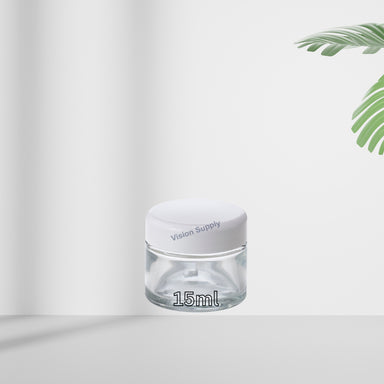
Clear glass lets the patient and the pharmacist see the product. Use it where light stability is not a concern and where a visual check matters, such as separated emulsions or crystallised preparations. We stock clear glass cream jars at 15ml, 30ml, 60ml and 120ml.

Plastic is lighter, cheaper and will not shatter. Use it for larger volumes and for patients who will handle the container daily. We stock a white plastic cosmetic jar at 100ml and a 500g cosmetic jar for high-volume preparations.

Sizing Your Fill

Order the container that fits the fill, not the container you have in stock. An underfilled jar leaves headspace, and headspace means air, and air oxidises. An overfilled jar contaminates the thread and stops the lid seating.

Our nominal sizes run 15ml, 30ml, 60ml, 100ml, 120ml and 500g. Most compounded topical prescriptions in Australia fall between 30g and 100g, so the 30ml, 60ml and 100ml sizes turn over fastest. Buying two or three sizes covers almost every script that comes across the bench.

Workflow and Good Compounding Practice

Compounded preparations sit under the Pharmacy Board of Australia's guidelines on compounding and the relevant state poisons legislation. The container and the label are part of that obligation.

Clean and dry every container before filling. Glass jars supplied in packs of 10 arrive clean but not sterile. If your preparation needs a sterile container, sterilise it in-house and document it.

Fill, cap and label in one continuous step. A filled jar left unlabelled on a bench is a dispensing error waiting to happen.

Label the container itself, not the outer bag. Include the patient name, the preparation, the strength, the quantity, the date, the expiry or beyond-use date, and the required cautionary and advisory labels. Our [pharmacy dispensary labels](/collections/pharmacy-dispensary-labels) and [cautionary and advisory labels](/collections/pharmacy-cautionary-advisory-labels) cover both.

Set a beyond-use date based on your formulation reference, not on the shelf life of the ingredients. Water-containing topical preparations usually get a much shorter date than anhydrous ones.

What Else Compounding Pharmacies Order

Jars are one part of the bench. Most compounding pharmacies order alongside them:

Liquid preparations go into [pharmacy bottles](/collections/pharmacy-bottles), with amber for light-sensitive solutions and clear for everything else. Tablet and capsule counts go into [phials and vials](/collections/pharmacy-phails). Anything supplied to a household with children needs a [child resistant closure](/collections/child-resistant-packaging). Cold chain items need [pharmacy fridge bags](/collections/pharmacy-fridge-bags).

Ordering the full bench in one delivery cuts freight and keeps your stock levels in step.

Buying in Packs of 10

Every jar in this range is supplied in packs of 10. That suits compounding volumes, where a pharmacy might turn over 20 jars of one size a month and 5 of another. You are not forced into a carton of 500 to stock a size you use occasionally.

Store empty containers boxed, capped and off the floor. Dust in an open jar is a contamination risk you cannot see once the preparation is in.

Frequently Asked Questions

Are these jars supplied sterile?

No. They are supplied clean in packs of 10. Sterilise in-house if your preparation requires it.

Which jars are light-resistant?

The amber glass jars at 30ml, 60ml and 120ml. Clear glass and white plastic do not block light.

Can I autoclave the glass jars?

Glass jars tolerate autoclaving. Plastic jars and lids generally do not. Check the individual listing before you sterilise.

What is the largest size you stock?

A 500g cosmetic jar, supplied in packs of 10.

Do the lids seal?

Yes. All jars are supplied with a matching lid. Check the listing for liner details.

Do you supply child resistant lids for these jars?

We stock child resistant caps for bottles. Contact us for jar closure options.